



Product Guide
The package contains the foam holding box, packing list, a blue ice box (or MCE® Cooling Rack), and compound product. After opening the package, please verify that all of the contents are present. If anything is missing or in error, please call 609-228-6898, and our after-sales staff will assist you.
A: We automatically send product Data Sheet and QA documents to your email after shipment. B: You can also download these files on the product webpage on [email protected]. C: Contact our customer service by calling 609-228-6898 or via email [email protected].
Most MedChemExpress (MCE) inhibitors are relatively stable at room temperatures, so if the blue ice melted it will not affect product quality. Products can be freely used.
For some special compounds which may be more environmentally sensitive, we will provide additional packaging to ensure product stability.
Recommended storage conditions and precautions regarding proper product handling are contained in the product COA.
Here are storage guidelines for some TYPICAL compounds:
| Powder: | -20°C | 3 years |
| 4°C | 2 years | |
| In solvent: | -80°C | 6 months |
| -20°C | 1 month |
If the solution is stored at -20°C for more than one month, it should be re-examined to ensure its efficacy. Avoid repeating freezing and thawing.
Storage conditions for some special products should refer to their COAs.
During transportation, the compounds may adhere to the neck or cap of the vial. Before opening the vial, please centrifuge to gather the compound at the bottom of the vial.
Select the appropriate solvent for the preparation of stock solution based on your experiment needs.
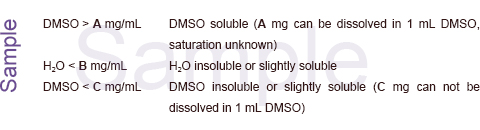
Solubility information is available at the product webpage. Currently we only offer solubility data in DMSO and/or water, for solubility of other solvents, please email to [email protected]. If you can not find the solubility information you are looking for, or you are having difficulty preparing a the product in solution form, you can also get help via the email above. Once prepared, aliquot the stock solution to routine usage volumes and store at -20°C or -80°C. Avoid repeated freezing and thawing.
Molarity Calculator from MedChemExpress (MCE) official website is recommended for the calculation: www.MedChemExpress.com/molarity-calculator.html
Stock solution using ddH2O as a solvent can be directly diluted with medium to prepare the working solution.
When DMSO is used to prepare the stock solution, the stock solution is diluted in the culture medium to prepare a working solution. Make sure the concentration of DMSO is <0.5% to avoid poisoning the cells. A negative control in the experiment is usually the culture medium with DMSO at the same concentration. It is recommended that the process of dilution is performed in a stepwise manner to avoid compound precipitating caused by fast change of concentration.
Stock solution using ddH2O as a solvent can be directly diluted with medium to prepare the working solution.
Stock solution using DMSO as a solvent can also be diluted with PBS or 0.9% NaCl to prepare the working solution. In order to reduce its toxicity to animals, the final concentration of DMSO in working solution should preferably be 2% or lower. When precipitates form during the dilution process due to their low water solubility, you can also use a co-solvent to help dissolve the compounds. Common co-solvents contain glycerol; Tween 80; sodium carboxymethylcellulose (CMC-Na); cyclodextrin; PEG400, etc. A suspension can also be used for oral or intraperitoneal injection. Please send an email to [email protected] if you require further assistance.
Methods of administration and solvent preparation used in paper may be available at the product webpage. MedChemExpress (MCE) has not independently confirmed the accuracy of these methods and they are distributed for reference only.
Administration volumes considered good practice (and possible maximal dose volumes):
| Species | Route and volumes (mL/kg) | |||||
|---|---|---|---|---|---|---|
| Oral | s.c. | i.p. | i.m. | i.v. (bolus) | i.v. (slow inj.) | |
| Mouse | 10 (50) | 10 (40) | 20 (80) | 0.05 (0.1) | 5 | (25) |
| Rat | 10 (40) | 5 (10) | 10 (20) | 0.1 (0.2) | 5 | (20) |
| Rabbit | 10 (15) | 1 (2) | 5 (20) | 0.25 (0.5) | 2 | (10) |
| Dog | 5 (15) | 1 (2) | 1 (20) | 0.25 (0.5) | 2.5 | (5) |
Conversion of different model animals based on BSA:
| Species | Weight (kg) | Body Surface Area (m2) | Km factor |
|---|---|---|---|
| Dog | 10 | 0.5 | 20 |
| Rabbit | 1.8 | 0.15 | 12 |
| Guinea pig | 0.4 | 0.05 | 8 |
| Rat | 0.15 | 0.025 | 6 |
| Hamster | 0.08 | 0.02 | 5 |
| Mouse | 0.02 | 0.007 | 3 |
| Animal A (mg/kg) = Animal B (mg/kg) multiplied by | Animal B Km |
| Animal A Km |
DMSO itself is strongly bactericidal and will not introduce bacteria to compounds. It is however important to keep the operating environment and the instrument be sterilized before experimental use. Compounds can also be sterilized by filtration prior to use depending on specific experimental requirements. High temperature and high pressure sterilization are NOT recommended.
Customised Recombinant Protein Services
MCE offers a wide selection of protein fusion tags, including His, GST, MBP, Flag, GFP, Fc, and Avi. Each tag demonstrates unique advantages in affinity purification, solubility enhancement, or detection, with their detailed characteristics listed in the table below.
We also provide tag-free protein custom services through two approaches: introducing a protease cleavage site between the tag and the target protein to remove the tag after purification, or directly constructing a tag-free expression plasmid and obtaining the target protein via methods such as ion-exchange chromatography.
| Tag | MW | Features |
|---|---|---|
| His | < 1 kDa | Smallest molecular weight; minimal interference to protein structure and function; most widely used and compatible with multiple tag combinations. |
| GST | ~ 26 kDa | Significantly enhances solubility of fusion proteins in cells; Large size, can be removed if needed. |
| Flag | ~ 1 kDa | Short, hydrophilic sequence causes minimal interference; Contains an enterokinase cleavage site for precise tag removal. |
| GFP | ~ 27 kDa | Fluorescent tag enabling real-time monitoring of expression, localization, trafficking, and interactions without staining. |
| Fc | ~ 25 kDa | Fusion leads to dimerization via disulfide bonds. |
| Avi | ~ 1.8 kDa | Short peptide tag for site-specific, homogeneous biotinylation of proteins. |
MCE offers both site-specific biotinylation and random biotinylation services. Customers can select the appropriate biotinylation method based on their experimental needs.
HABA assay is routinely included with the delivery of biotinylated proteins to verify successful biotin labeling and determine labeling efficiency.
Purification methods include affinity chromatography (AC), ion-exchange chromatography (IEX), hydrophobic interaction chromatography (HIC), and size-exclusion chromatography (SEC). The selection is based on customer requirements and the intrinsic characteristics of the target protein.
The features and typical applications of each purification method are as follows:
| Method | Features | Applications |
|---|---|---|
| AC | Utilizes specific binding between the protein and a ligand (e.g., His, GST, Flag tags) for highly efficient capture. | Ideal for purifying recombinant tagged proteins. |
| IEX | Separates proteins based on differences in their net surface charge at a specific pH. | Suitable for polishing steps of both native/tagged proteins or purifying recombinant tag-free proteins. |
| HIC | Separates proteins based on surface hydrophobicity. Binding is enhanced at high salt concentrations; proteins are eluted using a decreasing salt gradient for gentle separation. | Suitable for membrane proteins and highly hydrophobic proteins. |
| SEC | Separates proteins based on differences in their molecular size and shape in solution. | Typically used as a final polishing step to remove aggregates, degradation products, and other minor impurities. |
Protein purification from either the supernatant of cell lysate or inclusion bodies mainly depends on the properties of the target protein and the customer’s downstream application requirements.
For proteins expressed in soluble form, we usually purify directly from the cell lysis supernatant.
For proteins expressed as inclusion bodies, we provide professional inclusion body refolding services. Inclusion body purification generally follows a strategy of purification first, then refolding. In the refolding step, we screen various refolding buffers to identify the optimal conditions that allow the protein to reach a near-native state.
MCE custom proteins include the following default basic quality control tests: SDS-PAGE (for molecular weight identification and purity evaluation, with purity ≥90%), protein concentration determination, endotoxin testing (<1 EU/μg), and 0.22 μm membrane filtration for sterilization.
In addition, MCE custom proteins are generally supplied as lyophilized powder and shipped with blue ice. For customers with special requirements, liquid protein products can be provided upon prior confirmation and shipped with dry ice.
MCE does not apply a single universal default buffer. Commonly used buffer systems include PBS, Tris, and Hepes. We select the most suitable buffer based on the characteristics of the custom protein and downstream experimental requirements to ensure protein activity and stability.
In addition, stabilizers such as glycerol or trehalose, as well as mild detergents, can be supplemented into the buffer upon request to accommodate special protein properties or application scenarios.